
Self Help Tips
Warning: As with any exercise, therapy, or at home care, you should always ask your physician if it's right for you.
Correct Postures
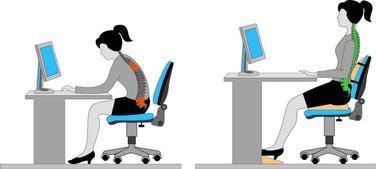
Correct posture limits un-due stress throughout the body, decreasing the stresses that cause aches and pains as well as degenerative changes. Below are some tips on how to help keep correct postures and avoid bad ones.
Sitting
- •Try to have knees at a 90 degree angle with feet on the floor.
- •Maintain your lumbar curve (support the low back with a pillow if needed...especially on the couch).
- •Keep your head over your shoulders, not jutted forward.
- •Do not roll shoulders forward for a prolonged period, sit with your chest "out".
- •If you are looking at a computer screen, have it to where you are not looking down too badly.
- •Break up your posture with multiple stretching breaks through out the day.
Tip: When sitting on a couch or softer chair be sure to have your low back (Lumbar) supported with a pillow, this will help you maintain the proper arch and prevent 'slouching'.
Standing
- •Try to distribute an equal amount of weight on both legs.
- •Try to have your head over your shoulders and not leaning forward.
- •When standing for a long period of time do not "lock" your knees.
- •If you stand a lot through out the day make sure to wear the correct style of shoe.
Laying Down
- •When on your back keep a pillow or rolled up blanket under your knees, keeping them slightly bent.
- •When on your side you may want to put a pillow in between your knees and ankles.
- •Try not to sleep with your head on your arm.
- •Try to keep your knees together...not touching, but in the same area.
Tip: Try to avoid sleeping on your stomach, as this is the worst position to sleep in.
Ice and Heat

The question 'When do I use ice and when do I use heat?' is a popular one. Here is some advice that can help answer this question.
Ice
Ice is typically used in the acute and/or sub-acute phase of an injury/flare-up, this includes new injuries and after exercise/repetitive activities. Ice can help relieve the aches and pains of an injury by slowing down the nerve receptors/impulses of the affected area, allowing us to feel less pain.
How to use: Use an ice pack or bag of ice, wrap it in a dish towel, apply to area of pain or swelling for 10-15 minutes, re-apply if needed around an hour or so later...up to three times/day.
Good for: Sprains/Strains, Relieving pain after working out, Joint/muscle pain, and Swelling.
Warning: DO NOT APPLY ICE PACK DIRECTLY ONTO SKIN...MAY CAUSE A BURN.
Heat
Heat is typically used to help 'calm down' tight and sore muscles and spasms. Moist heat penetrates deep into the soft tissues causing increased circulation by dilating the vessels, allowing for new inflammatory factors to be 'brought in'. This increased blood flow can help relax a muscle, relieving some of the 'tightness'. Generally heat is used in the sub-acute and chronic phase of care.
How to use: Use a microwavable heat pack or wet a dish towel, ring it out good and microwave it for a minute or so, wrap a dry dish towel around the heat pack/moist towel, apply it to the area of tightness or spasm for 10-15 minutes.
Good for: Tight muscles, Spasms, Minor aches and pains, and Sub-acute/chronic injuries.
Warning: DO NOT APPLY HEAT PACK/MOIST TOWEL DIRECTLY ONTO SKIN....MAY CAUSE A BURN.
Yoga
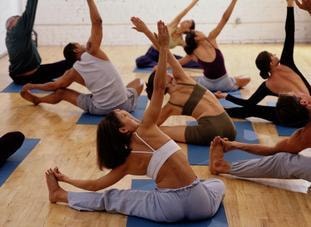
Be sure to include some sort of stretching or yoga routine in your work out program. Remember, a healthy muscle is not only strong but also elastic. The word YOGA means "union" in the ancient Indian language of Sanskrit. Yoga is rooted in the belief that the body and breath are intimately connected with the mind; and, you can experience the mind/body connection using the breath as a bridge.
As more people turn to yoga, both as a physical and spiritual activity, they may discover Chiropractic care has new-found benefits. Chiropractic care can help many beginners who may be more prone to injuries, such as muscle strains and joint pain resulting from yoga's sometimes difficult and strenuous stretches. Chiropractic and yoga can work in harmony to increase proper posture, range of motion and flexibility: all crucial elements to both practices.
Hydration
Water is the most essential ingredient to a healthy life. Depending on factors such as age, gender and weight, it makes up between fifty-five to seventy-five percent of the human body. Water is involved in every system in the body. It moistens the oxygen we breathe, regulates our body temperature and protects our vital organs. Water helps to convert the food we eat into the energy we need, while carrying nutrients and oxygen to every cell in our body and then carries the carbon dioxide our cells produce away. It also cushions our joints so that we are able to move without our bones rubbing against one another.
It is recommended that we consume around .5 fl oz of water per body pound daily. This means if you weigh 150 lbs you should consume around 75 fl oz per day....75/8 = 9+ cups of water/day.